How Many Watts Does an Induction Burner Need?
An induction burner wattage of up to 1,800 watts suits most everyday cooking. Choose useful low settings for simmering, and check how double burners share power before planning two high-heat tasks.
On this page (8 sections)
- How much induction burner wattage do you need?
- Which single burner suits your cooking?
- How much power does a double induction burner use?
- What electrical requirements should you check?
- Which wattage setting should you use?
- Does pan size affect the wattage you need?
- How should you set up and care for the burner?
- Which induction burner wattage should you choose?
An induction burner wattage of up to 1,800 watts suits most everyday cooking, from boiling pasta water to frying vegetables. For sauces and small portions, useful low settings matter just as much as maximum output.
Choose around your busiest meal: 1 pan needing strong heat, or 2 pans needing different heat levels. A double burner adds cooking space, but its zones may share the appliance's total power.
How much induction burner wattage do you need?
Choose up to 1,800 watts for general cooking, then compare the lower settings and controls. If you mostly warm soup or cook small portions, you may rarely need maximum output.
Match induction burner wattage to your meals
Use these tasks to narrow your choice:
- Boiling water: Favor a higher maximum, especially for larger pots, and use a lid when the recipe allows.
- Frying and sautéing: Look for easy adjustments so you can reduce heat quickly as food browns.
- Sauces and gentle simmering: Favor useful low settings rather than choosing by peak power alone.
- Cooking 2 dishes: Check shared output and plan which pan needs the stronger heat.
Wattage measures power, while kilowatt-hours measure energy used over time. Running at 1,000 watts continuously for 30 minutes uses 0.5 kilowatt-hours; a burner that cycles its output won't necessarily draw that amount throughout the meal.
For a wider comparison of cooktop formats and controls, see our induction cooktop buyer's guide.
Which single burner suits your cooking?
Choose the Duxtop for more power steps or the ChangBERT for frequent use with physical buttons. Both reach the same maximum, so the useful differences are their controls, construction, and intended workload.
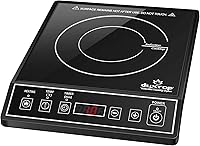
Duxtop 9600LS: for everyday meals and more power choices
The Duxtop suits home cooks who want one extra cooking zone with room to adjust heat. Its 20 preset power levels give you more choices between the bottom and top settings than the ChangBERT.
Touch controls, a child safety lock, and dedicated boil and keep-warm buttons suit a kitchen where different people use the burner. The lock helps prevent accidental setting changes once cooking is underway.
Skip it if you need 2 pans cooking at once or strongly prefer buttons you can feel. More power steps also don't promise perfectly steady heat at every setting, so watch delicate food and adjust as needed.
Our Duxtop 9600LS review covers its controls and cookware requirements in more detail.
ChangBERT: for frequent cooking and tactile controls
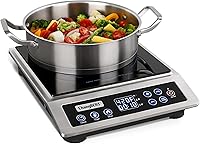
Choose the ChangBERT if you want a single burner with push buttons and stainless steel housing. ChangBERT designs its continuous-duty circuitry for extended use and backs home use with a 2-year limited warranty and commercial use with a 1-year limited warranty.
Its NSF certification makes it worth considering for buyers whose work setting calls for commercial equipment. Confirm your own kitchen's equipment requirements before choosing it for that role.
Skip it if your priority is having the most power increments for small adjustments. Its coil size is useful for pan matching, but a large glass surface still doesn't mean every oversized pan will heat evenly.
How much power does a double induction burner use?
Treat a double burner's stated wattage as a whole-appliance limit unless its instructions say otherwise. Separate controls let you select different settings, but both zones still work within the available power.
The Nuwave Double Pro and PIC Double use Dynamic Watt Technology to allocate energy between their zones. Plan meals around one demanding task and one gentler task rather than expecting two full-power single burners.
Nuwave Double Pro: for a main dish and a side
The Double Pro suits cooks who want to boil or fry on one side while keeping a sauce or side dish going on the other. Each zone has its own controls.
Its temperature choices run from 50°F to 575°F in 5-degree increments, and its Precision Key gradually raises heat toward the selected setting. A safety lock helps prevent accidental changes.
At 23.6 inches wide and 14 pounds, it needs more counter and storage space than a single burner. Skip it if you usually cook with 1 pan or need 2 zones delivering maximum heat together.
Nuwave PIC Double: for two-pan meals and heavier cookware
The PIC Double suits buyers who want separate controls and two 8-inch heating zones for paired dishes. Each side supports up to 25 pounds, including the cookware and its contents.
Its 106 temperature settings and Precision Key suit cooks who prefer choosing a temperature rather than only a numbered power level. Keep checking the food, since a selected temperature doesn't mean every part of the meal has reached it.
Skip it if you'll move the burner often: it weighs 15.7 pounds. Its core power options overlap with the Double Pro, so extra weight doesn't buy extra maximum output.
Our single versus double induction cooktop guide can help you decide whether a second zone earns its counter space.
What electrical requirements should you check?
Match the burner to its required voltage, outlet, and circuit capacity before cooking. A plug fitting an outlet doesn't establish that the circuit can handle the cooktop alongside other appliances.
The Duxtop requires a 110/120-volt, 15-amp outlet. At 120 volts, dividing 1,800 watts by voltage gives about 15 amps, which shows why another large appliance on the same circuit can cause trouble.
Follow the exact model's instructions for circuit requirements and any restrictions on extension cords. Plug directly into a suitable wall outlet, and don't route the cooktop through a power strip.
A lower wattage option can reduce demand, but it doesn't confirm that an RV supply, inverter, or shared circuit is suitable. Include other connected loads when checking capacity.
See whether an induction burner can plug into any outlet for more on electrical compatibility. Ask a qualified electrician if you can't confirm the circuit's capacity.
Which wattage setting should you use?
Use high power to heat quickly, then reduce it to maintain the cooking action you need. Leaving a burner at maximum after water boils wastes energy through extra steam and can make food boil over.
For frying, preheat gradually and follow the cookware maker's directions. An empty pan can overheat quickly, so don't start every task at full power.
For simmering, look for small, steady bubbles and adjust after adding ingredients. A cold batch of food may need a temporary increase before you return to gentle heat.
Power mode controls heating input; temperature mode aims for a selected temperature using the cooktop's controls. Neither replaces checking the food, and numbered settings don't translate directly between brands.
With shared-power double burners, bring water to a boil before starting another demanding task. Once the pot can simmer at lower power, more of the available output can serve the second pan.
Does pan size affect the wattage you need?
Choose magnetic cookware with a base that fits the heating zone before seeking more watts. Extra power can't make an incompatible pan work or spread heat evenly across any pan size.
A magnet sticking firmly to the base is a useful compatibility check. Also follow the burner's minimum and maximum cookware dimensions; the Duxtop requires a magnetic bottom at least 5 inches across.
Measure the flat base rather than the rim of a flared frying pan. The printed circle and glass surface don't necessarily show the exact heating coil size.
Use flat-bottomed cookware and center it over the zone. For more help matching dimensions, read what size pan fits an induction burner.
How should you set up and care for the burner?
Place the cooktop on a stable, level surface with ventilation clearances required by its manual. Keep towels, loose paper, and other items away from air vents.
Leave room for pan handles without putting them over a counter edge. On a double burner, check that both pans fit together without crowding the controls or pushing either pan off-center.
Lift pans instead of sliding them across the glass. Wipe the pan base before use so trapped grit doesn't scrape the surface.
Let the burner finish its cooling cycle, then unplug it and allow the surface to cool before cleaning. Heat from the pan can leave the glass hot after cooking stops.
Use a soft cloth and a cleaner approved by the manufacturer. Don't immerse the appliance or allow cleaning liquid into vents, and remove spills before the next cooking session.
Which induction burner wattage should you choose?
Choose induction burner wattage around your meal plan and electrical supply, then use the controls and footprint to break the tie. Peak output matters most for heating quickly; low settings and shared-power behavior matter during the rest of the meal.
Pick the Duxtop for everyday single-pan cooking with more power steps. Choose the ChangBERT for tactile buttons and frequent use, especially where its commercial certification matters.
Choose the Double Pro for two-dish meals if its size fits your counter. Pick the PIC Double if its zone layout and temperature controls suit you and the added carrying weight won't be a burden.
Before your first meal, read how to use a portable induction cooktop to set up the burner and start with suitable cookware.
Frequently asked questions
How many watts does a portable induction burner use?
Many portable induction burners have a maximum of 1,800 watts, but actual power use depends on the selected setting and how the burner controls heat. Maximum wattage describes available power, while electricity used over a meal also depends on time.
Compare both the upper limit and the lower cooking settings.
Is a 1,800-watt induction burner powerful enough?
A 1,800-watt induction burner suits everyday boiling, frying, and simmering with compatible cookware. Large batches take longer to heat than small ones, and a wide pan still needs a suitable cooking zone.
Choose useful low-power controls as well, especially if you often cook sauces or small portions.
Do two-burner induction cooktops use 1,800 watts per burner?
No, a double cooktop can have a shared 1,800-watt maximum for the whole appliance. Independent controls let you choose different heat settings, but they don't create extra electrical capacity.
Check total output and power-sharing behavior, especially if you want to boil water and sear food at the same time.
Does higher wattage always mean faster cooking?
Higher available wattage can shorten heating time when other conditions are similar, but cookware and food quantity still matter. A compatible pan with a suitable base helps use that power well.
Once food reaches a simmer, extra power usually makes it boil harder rather than making every recipe finish sooner.