Best 2-Burner Induction Cooktops: Top 3 Picks (October 2026)
The best 2-burner induction cooktops include the Duxtop 9620LS Double Induction Cooktop for everyday family meals, the Nuwave Double Pro Induction Cooktop for repeat recipe routines, and the Nuwave PIC Double Induction Cooktop for careful sauce cooks.
On this page (9 sections)
- Which 2-burner induction cooktop fits your cooking style?
- How we chose these double induction cooktops
- What should you check before buying a 2-burner induction cooktop?
- Which controls matter for the meals you cook?
- How should you set up a double induction cooktop?
- How do you plan meals around shared burner power?
- How do you clean and care for a double induction cooktop?
- What mistakes should you avoid with two induction burners?
- Which 2 burner induction cooktop should you choose?
The Duxtop 9620LS Double Induction Cooktop is the best 2 burner induction cooktop here for everyday meals that pair a main dish with a side. Choose the Nuwave Double Pro for saved cooking settings, or consider the PIC Double if fine heat adjustments are your main priority.
A double burner helps most when your meals regularly need two pans at once. Start with our single vs double induction cooktop comparison if you're still deciding whether the second zone earns its counter space.
The key buying checks are shared power, cookware fit and working space. Two heating zones give you more ways to arrange a meal, but they don't turn a countertop appliance into two full-power standalone burners.
Our picks at a glance
-
1
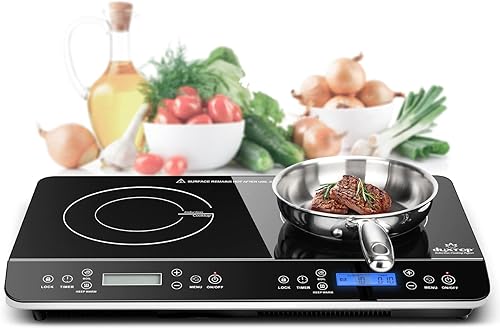 Best for everyday family meals
Duxtop 9620LS Double Induction Cooktop
8.2/10 our score
See it on Amazon -
2
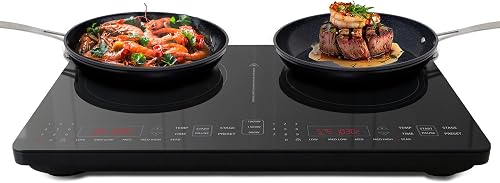 Best for repeat recipe routines
Nuwave Double Pro Induction Cooktop
7.8/10 our score
See it on Amazon -
3

Which 2-burner induction cooktop fits your cooking style?
Choose the Duxtop for everyday two-pan meals, the Double Pro for repeat recipes and the PIC Double for careful heat adjustments. Both Nuwave models offer similar temperature control, so their extra features and handling matter more than the number of settings alone.
Duxtop 9620LS Double Induction Cooktop
- Independent zone settings
- Power and temperature modes
- LCD touch controls
- 10-hour countdown timer
A clear choice for cooks who want a stronger main burner and a second zone for a side dish. Its two control modes suit common stovetop tasks.
Pros
- Separate settings for each zone
- Child safety lock and voltage warnings
- Duxtop provides a 2-year manufacturer warranty
Cons
- Right burner has a lower power limit
- Cookware must meet a 5 in minimum diameter
The Duxtop 9620LS suits a cook who wants to put a main dish on one side and manage a smaller task beside it. Its LCD touch panel provides separate zone settings without requiring you to use the same cooking mode on both sides.
Duxtop recommends temperature mode for frying, steaming and sautéing, and power mode for keeping food warm or bringing water to a boil. The choice is useful if you prefer thinking about either a heat level or a temperature target.
Put the more demanding task on the stronger left burner. The lower-powered right side makes more sense for a sauce or side dish than as an equal partner for two demanding high-heat jobs.
Choose it if you want straightforward meal preparation and value a child safety lock, pan detection and voltage warnings. Skip it if equal burner capacity is central to your routine, or if your smallest cookware falls below its minimum size.
Nuwave Double Pro Induction Cooktop
- Independent burner controls
- 50 programmable presets per burner
- Selectable power limits
- 99-hour timer
Saved settings and a gradual-heating Precision Key suit cooks who return to the same recipes. Its selectable wattage helps you plan around an available electrical supply.
Pros
- Dynamic Watt Technology shares available power
- Cookware detection and safety lock
- Supports up to 25 lb per cooking surface
Cons
- Requires a broad counter area
- 14 lb weight matters for frequent moving
The Nuwave Double Pro suits cooks who repeat favorite recipes and want to keep useful settings close at hand. Its 50 programmable presets per burner give it a clearer reason to buy than temperature range alone.
The Precision Key is designed to bring heat up gradually toward the selected temperature. Nuwave says its Dynamic Watt Technology allocates available energy between the burners based on their settings.
Its selectable power limits help you plan around an electrical supply, though a lower limit also leaves less energy for cooking. The long timer provides scheduling flexibility, but it isn't a reason to leave an active cooktop unattended.
Choose the Double Pro if you will use its saved settings and power options regularly. Skip it if you want only occasional boiling and reheating, or if moving a broad appliance between a cabinet and counter would discourage you from using it.
Nuwave PIC Double Induction Cooktop
- 106 temperature settings
- Two 8 in heating zones
- Independent control panels
- Precision Key
Small temperature steps suit cooks who adjust sauces and other heat-sensitive dishes while another pan cooks beside them. It offers a similar temperature range to the Double Pro.
Pros
- Dynamic Watt Technology manages both zones
- Supports up to 25 lb per side
- Nuwave provides a 1-year limited manufacturer warranty
Cons
- Heaviest pick at 15.7 lb
- Control descriptions differ; confirm the interface before buying
The Nuwave PIC Double suits cooks who want small heat adjustments while working with two pans. Its 106 temperature settings give you many starting points for sauces, melting and other tasks that need close attention.
Independent control panels let you change one dish without changing the other. Like the Double Pro, it has a Precision Key and Nuwave's Dynamic Watt Technology, so fine adjustment isn't an advantage unique to this model.
Each side supports up to 25 lb, but weight capacity doesn't settle cookware fit. Our guide to induction burner and pan size explains why the flat base matters more than the width across the rim.
Choose it if its heat controls fit your routine and it will mostly stay in one place. Skip it for frequent carrying, and confirm the control interface before ordering because Nuwave's descriptions refer to both push-button and touch operation.
How we chose these double induction cooktops
We prioritized useful controls, two-pan meal planning and practical fit over the longest feature list. The Duxtop leads because its two modes and stronger main burner make a clear everyday setup.
The Double Pro follows for its saved settings and selectable power limits. The PIC Double offers fine adjustment too, but shares several core features with the higher-ranked Nuwave and weighs more.
These recommendations come from comparing the models' specifications and functions. For more on choosing a countertop appliance you may need to move or store, see our guide to portable induction cooktops.
| Product | Best for | Zones | Controls | Power | Our score |
|---|---|---|---|---|---|
| Duxtop 9620LS Double Induction Cooktop | everyday family meals | 2; left up to 1800 W, right up to 1000 W | LCD touch panel; 20 levels per mode | 120 V, 1800 W total rating | 8.2 |
| Nuwave Double Pro Induction Cooktop | repeat recipe routines | 2; 8 in heating coils | Touch; 50°F to 575°F in 5°F steps | 120 V; 900, 1500 or 1800 W | 7.8 |
| Nuwave PIC Double Induction Cooktop | careful sauce cooks | 2; 8 in heating zones | 50°F to 575°F in 5°F steps | 115 V, 1800 W | 7.5 |
What should you check before buying a 2-burner induction cooktop?
Check the outlet, your actual pans and the full working area before comparing extra functions. A model that passes those checks is more useful than one with more settings that doesn't suit your kitchen.
How much power does a 2-burner induction cooktop provide?
These models have an 1800 W overall rating, so plan your meal around a shared supply. Separate controls let you request different heat levels, but they don't remove the appliance's total power limit.
Duxtop's individual burner limits shouldn't be added together to estimate combined output. The same principle applies to power management on the Nuwave models: sharing energy cannot create extra electrical capacity.
For pasta and sauce, start heating the water first, then use the second zone for the gentler task. If both dishes need strong heat at the same moment, stagger the steps rather than expecting two maximum-output burners.
Check the circuit as well as the receptacle, especially if a kettle, microwave or other appliance uses it. Our guide to induction burner amps and outlet needs covers the electrical questions to check before plugging in.
What pan sizes fit the heating zones?
Choose cookware by its flat magnetic base, not just its advertised top diameter. A wide rim can hide a much smaller base, and two pans that fit separately may crowd each other together.
A magnet that sticks firmly to the bottom is a useful first compatibility check. Still confirm the cooktop's cookware requirements, since magnetic material alone doesn't settle minimum size or shape.
Duxtop requires a minimum cookware diameter of 5 in, while both Nuwave models have 8 in heating zones. That zone measurement doesn't establish every supported pan size or guarantee even heat across an oversized base.
Measure the pans you actually use, including handles and lids. Our guide to matching induction burner and pan sizes helps you compare the heating area with the part of the pan touching the surface.
How much counter space do you need?
Allow room for the cooktop, required clearances and safe pan handling. A counter that barely holds the appliance may leave no place to set down a lid or turn a handle safely.
The Double Pro measures 23.6 in wide, 14.2 in deep and 2.6 in high. The PIC Double is the same width and height, with a depth of 14.1 in.
Confirm the Duxtop's footprint before ordering because its supplied dimensions have unclear orientation. Don't choose it for a narrow gap based on those measurements alone.
Map out the usable counter with paper, then place your cold pans within that area. Check for handles over the edge, blocked controls and enough room to lift a full pot without hitting a wall or cabinet.
Will you leave it out or put it away?
Choose a storage plan you can manage with both hands and a clear route. Frequent lifting can matter more than a small difference in thickness.
The Duxtop weighs 12.8 lb, the Double Pro 14 lb and the PIC Double 15.7 lb. If you will move the unit after every meal, compare those weights with the height and depth of your storage shelf.
Store it only after it has cooled, and protect the glass from loose cookware or heavy objects. Don't assume a countertop model is suitable for a recessed installation; follow its installation instructions.
Which controls matter for the meals you cook?
Choose controls around your usual cooking tasks, rather than the highest temperature or largest setting count. Boiling water, reducing sauce and cooking pancakes each call for a different kind of adjustment.
Power mode suits changes you can see
Power settings are useful when you want more or less heat and can judge the result directly. Watch the strength of a boil, the speed of a reduction or how quickly food browns.
Start below maximum for a task you haven't cooked on induction before. A quick response makes small adjustments useful, while an aggressive start can leave you chasing heat after food begins to catch.
Temperature mode gives you a starting point
A selected temperature helps you return to a familiar setting, but it doesn't measure the center of your food. Pan construction, food quantity and stirring still affect the result.
For a sauce, watch its texture and bubbling as you adjust. For meat or other food with an internal temperature target, use an appropriate food thermometer rather than relying on the cooktop display.
Fine steps help only if you use them
Small temperature increments suit cooks who make careful changes during a recipe. They are less valuable if your routine consists mainly of boiling water, reheating soup and turning the heat down by feel.
Both Nuwave models provide the same stated temperature range and step size. Choose between them by saved settings, handling and the interface you prefer, rather than assuming the PIC Double offers finer control.
Timers should match a real task
A timer is useful for keeping track of a reduction or a timed cooking stage. Duxtop provides a countdown timer up to 10 hours, while the Double Pro offers one up to 99 hours.
A long timer doesn't make every recipe suitable for prolonged cooking. Stay nearby, watch liquid levels and use a separate reminder if several dishes need attention at different times.
How should you set up a double induction cooktop?
Set the unit on a stable, level surface with the required ventilation, then check the cord and cookware before cooking. A clear setup makes it easier to manage both zones without reaching over hot pans.
Read the model's instructions for clearances, placement and electrical connection. Don't cover vents with towels, packaging or a protector that the instructions don't allow.
Arrange the work area before heating
Put ingredients, utensils and a safe place for lids within reach. Keep the controls accessible, and turn handles so they won't catch clothing or extend into a walkway.
Keep the cord away from hot cookware, water and counter edges. Follow the connection instructions rather than treating a power strip or extension cord as a routine way to reach the outlet.
Start with a simple two-pan meal
Learn the controls with a meal that pairs one demanding task with one gentle task, such as pasta and sauce. This shows how the appliance behaves when both zones are active.
Start the longer task first, then add the second pan when it needs attention. Lower the heat before a pot boils over, rather than waiting until liquid reaches the controls.
Check each zone before adding food
Make sure the pan sits flat and centered and that you've selected the intended zone. A brief check avoids adjusting the wrong burner while another pan keeps heating.
Follow the manual's start-up sequence and avoid prolonged heating of empty cookware. Our guide to using a portable induction cooktop walks through the basic controls and cooking steps.
How do you plan meals around shared burner power?
Give the most demanding task first access to the available power, then bring in the second dish. This approach helps a double burner handle a meal without treating both zones as full-size range burners.
For pasta, bring the water to a boil before starting a sauce that needs only gentle heat. Once the pasta is cooking, use the lowest setting that maintains the boil you need.
For a skillet meal with vegetables, prepare the ingredients for both pans before heating either one. Cook the part that tolerates resting first, leaving the last-minute task for the stronger heat demand.
Two wide skillets create a different problem from a saucepan beside a pot. Even if both bases suit induction, their walls and handles can make stirring and lifting awkward.
If your normal meal requires two large pans at high heat together, reconsider this format. Our complete induction cooktop guide explains the broader choices, including setups with more cooking capacity.
How do you clean and care for a double induction cooktop?
Clean cooled glass and pan bottoms regularly so spills and grit don't become the next meal's problem. A smooth surface is easier to wipe when food hasn't been left to build up.
Turn the cooktop off and follow the manual's cooling and unplugging instructions. Glass can remain hot from contact with cookware even though induction heats the pan directly.
Wipe spills without flooding the controls
Use a soft cloth and a cleaner approved for the surface. Apply only as directed, and keep excess liquid away from vents, connections and the control area.
Sugary spills may need prompt care under the manufacturer's instructions. Don't reach across hot cookware or use an abrasive tool just to remove a mark faster.
Lift cookware instead of dragging it
Check the bottom of a pan before placing it on the glass. Food residue or grit trapped underneath can scratch the surface when you slide the pan.
Lift heavy pots with secure handles, keeping them level. A stated weight capacity doesn't make it safe to drop cookware onto the glass or lean on the appliance.
Keep airflow clear between meals
Look around the ventilation openings when you clean the counter. Crumbs, nearby packaging and cloths can interfere with airflow if they gather around the unit.
Let the cooktop complete any cooling process described in its instructions before moving it. Store the cord without pulling it tightly around the appliance or placing weight on its connection.
What mistakes should you avoid with two induction burners?
Avoid crowded cookware, mismatched heat demands and unattended cooking. Those habits matter more to a useful setup than choosing the model with the most adjustments.
Buying for the biggest pan you might use
Buy around the pans you use every week, then check occasional cookware separately. An oversized stockpot can crowd the second zone even when it works on its own.
Check access to the controls with both pans in place. If a handle blocks a setting you need to change, the setup is already awkward before any food gets hot.
Starting every task at maximum heat
Use high heat for tasks that call for it, such as bringing water to a boil. Begin more cautiously with oil, butter, thick sauces and small amounts of food.
A setting that suits a full pot can be excessive for a small saucepan. Adjust for the amount in the pan, rather than carrying one familiar number from every recipe to the next.
Treating a safety lock as supervision
A safety lock helps prevent unintended control changes, but active cooking still needs attention. Keep children away from hot pans and handles, including after you turn off the zone.
Cookware detection also doesn't mean the glass becomes cool when a pan is lifted. Leave hot cookware on a suitable surface and keep the cooking area clear until everything has cooled.
Choosing features you won't use
Saved settings are worthwhile when you repeat recipes and want a convenient starting point. They add less to a routine built around a few simple heat adjustments.
Likewise, a broad temperature range shouldn't outweigh a poor storage fit. Choose the cooktop you can set up comfortably and use with your existing meal habits.
Which 2 burner induction cooktop should you choose?
Choose the Duxtop 9620LS if your meals usually pair a higher-heat main task with a gentler side dish. Its two control modes make it the clearest everyday choice here, provided your cookware meets the minimum size.
Pick the Nuwave Double Pro if you will use saved settings and selectable power limits. Choose the PIC Double if its fine adjustments suit your sauce work and you can comfortably leave the heavier unit in place.
Before buying a 2 burner induction cooktop, lay out your two most-used pans and confirm the electrical setup. If the Double Pro best matches that plan, read our Nuwave Double Pro review for a closer look at its features.
Our top 3 picks at a glance
-
1
Best for everyday family meals
Duxtop 9620LS Double Induction Cooktop
8.2/10 our score
See it on Amazon -
2
Best for repeat recipe routines
Nuwave Double Pro Induction Cooktop
7.8/10 our score
See it on Amazon -
3
Frequently asked questions
Can both burners on a 2-burner induction cooktop run at once?
Yes, all 3 models let you use both cooking zones with separate settings. They still have a shared overall power limit, so independent controls do not mean both sides deliver their individual maximum output together.
Plan one high-heat task alongside a lower-heat task, and follow the instructions for power sharing.
What cookware works on a 2-burner induction cooktop?
Use cookware with a flat, magnetic base that meets the cooktop's size requirements. Cast iron and some stainless steel pans work, while aluminum or copper needs a compatible magnetic base.
Check each pan separately, including small saucepans, and make sure both pans fit together without touching or covering the controls.
How much power does a double induction cooktop use?
These models have an 1800 W maximum rating, but actual draw depends on the selected settings and active zones. A lower setting does not mean constant draw at the maximum.
Don't add individual burner limits to calculate total consumption; our guide to induction burner wattage explains the difference.
Is a double induction cooktop suitable for an RV?
Yes, if the RV's electrical supply, counter space and ventilation meet the cooktop's requirements. The Double Pro has selectable power limits that can help you plan electrical use.
Account for other appliances on the same circuit, secure the unit before travel, and let it cool before putting it away.
Does a temperature setting tell you the food's temperature?
No, a cooktop's temperature setting is not a direct measurement of the food inside your pan. Cookware, food quantity and stirring affect the result.
Use the setting as a starting point, adjust to the food's behavior, and use a suitable food thermometer when internal temperature matters.